
J Gresham Machen's Warrior Fatherhood
How Machen created generations to fight a religious war

On May 27, 2023, I got past the fear and started writing1 about harmful aspects of Reformed Presbyterian theology and culture. I started out by quoting John Frame:
“Machen died of pneumonia in 1937, disappointed that his new denomination was already showing signs of division. Machen’s children were theological battlers, and, when the battle against liberalism in the PCUSA appeared to be over, they found other theological battles to fight. Up to the present time, these and other battles have continued within the movement, and, in my judgment, that is the story of conservative evangelical Reformed theology in twentieth-century America.”2 (bolding is mine)
As I’ve been researching Reformed Presbyterian history, I see this warrior ethos is present is so many places and so many prominent leaders.
SCHAEFFER AND McINTIRE
Francis Schaeffer emphasized this need for warfare in the late 1970s until his death in 1984.

He taught that Christians had a duty to fight war against tyranny and that the tyranny of of 1982 was worse than that of 1776.3
As I traced Schaeffer’s influences, he was a follower of Carl McIntire, a fiery, angry, political and religious agitator that has a massive radio presence in the 1950s and 1960s and beyond. One example is when McIntire went to war against the RSV Bible by distributing this pamphlet (my own copy):
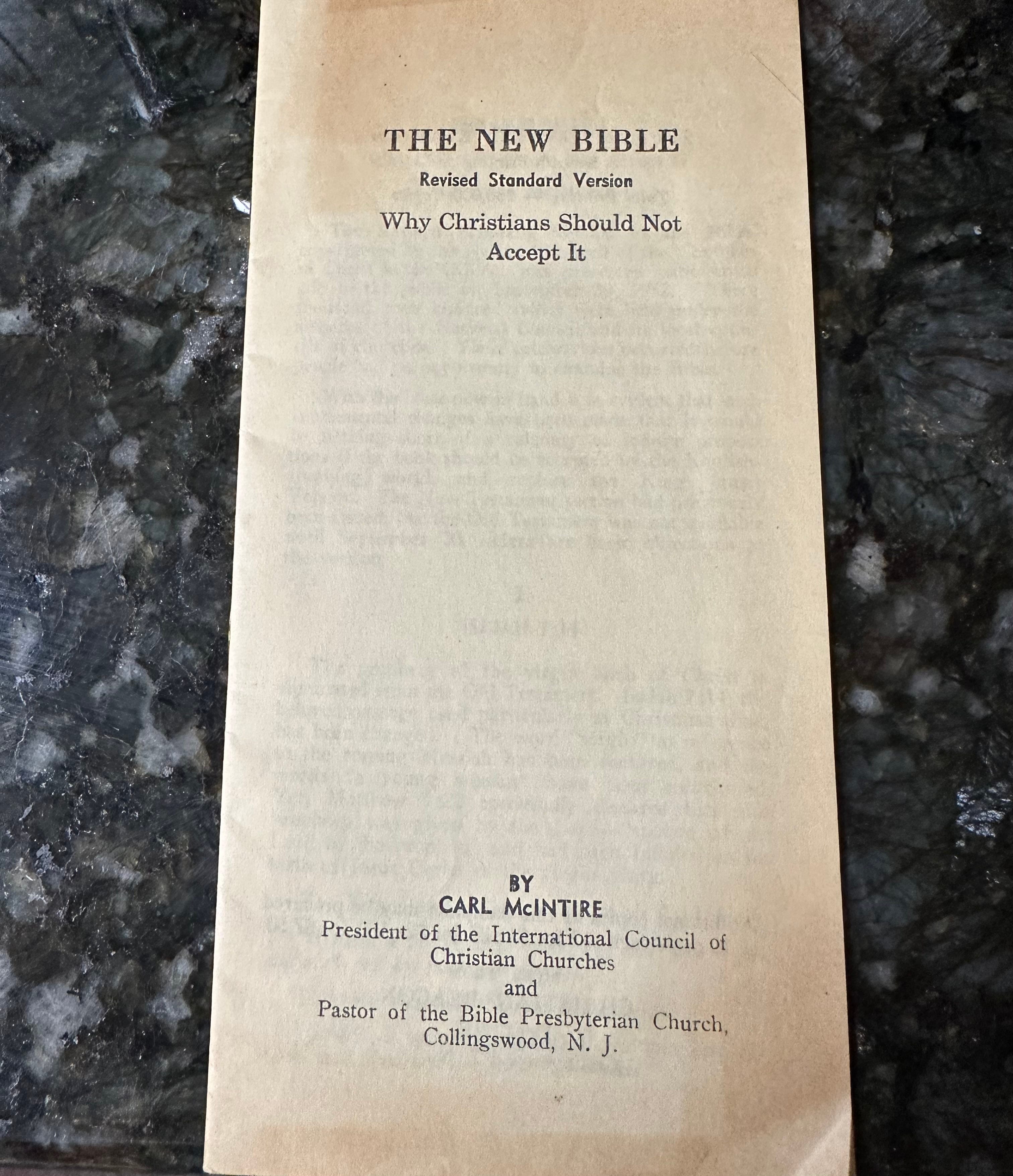
“Pastors across the nation were not pleased. They cited Reverend McIntire's leaflet as the grounds of their righteous indignation. To the alarm of local fire chiefs everywhere, some ministers hosted public burnings of the RSV Bible.”4
SEPARATISTS GONE WILD
Francis Schaeffer went to Westminster Seminary for two years (1935-1936) before Carl McIntire divided to start his own seminary — Faith Seminary in Wilmington, DE.
“Schaeffer transferred to Faith with the MacRae-McIntire group and is usually considered the new seminary's first student. The Faith group formed not only a new seminary but also a fundamentalist denomination called the Bible Presbyterian Church, which actually began in the spring of 1937, just months before fore the first fall semester at Faith Seminary. Shortly after graduating from Faith, Schaeffer became the first minister ordained by the Bible Presbyterians.”5
To Schaeffer’s credit, the warfare ethos of Carl McIntire bothered him and he ended up cutting ties (but Schaeffer reverted to that ethos late in life).
“While Schaeffer would eventually weary of McIntire's militancy, he never lost the separatist tendency that developed within fundamentalism mentalism and that was part of the split from Westminster.”6
McINTIRE AT PRINCETON
Carl McIntire went to seminary at Princeton (1928-1929) before the exiting with Machen and Van Til.7
“Machen welcomed McIntire into the inner circle of his favored students, one that met informally at discussion meetings at his home.”8
On March 10, 1929, Machen delivered a sermon called “The Good Fight of Faith.” Here are some quotes — you can read the entire sermon here, bold emphasis mine below.
The Apostle Paul was a great fighter. His fighting was partly against external enemies—against hardships of all kinds.
Far more trying was the battle that he fought against the enemies in his own camp.
Everywhere we see the great apostle in conflict for the preservation of the church.
…not for one moment did Paul have peace; always he was called upon to fight.
Fortunately, he was a true fighter; and by God’s grace he not only fought, but he won.
The human instruments, however, which God uses in great triumphs of faith are no pacifists, but great fighters like Paul himself.
The real companions of Paul are the great heroes of the faith. But who are those heroes? Are they not true fighters, one and all? Tertullian fought a mighty battle against Marcion; Athanasius fought against the Arians; Augustine fought against Pelagius; and as for Luther, he fought a brave battle against kings and princes and popes for the liberty of the people of God. Luther was a great fighter; and we love him for it. So was Calvin; so were John Knox and all the rest. It is impossible to be a true soldier of Jesus Christ and not fight.
God grant that you—students in the seminary—may be fighters, too!
The Christian life is a warfare after all. John Bunyan rightly set it forth under the allegory of a Holy War; and when he set it forth, in his greater book, under the figure of a pilgrimage, the pilgrimage, too, was full of battles.
Pray God that in that conflict you may be true men; good soldiers of Jesus Christ, not willing to compromise with your great enemy, not easily cast down, and seeking ever the renewing of your strength in the Word and sacraments and prayer!
You will have a battle, too, when you go forth as ministers into the church. The church is now in a period of deadly conflict. The redemptive religion known as Christianity is contending, in our own Presbyterian Church and in all the larger churches in the world, against a totally alien type of religion. As always, the enemy conceals his most dangerous assaults under pious phrases and half truths.
Soldiers in bayonet practice were sometimes, and for all I know still are, taught to give a shout when they thrust their bayonets at imaginary enemies; I heard them doing it even long after the armistice in France. That serves, I suppose, to overcome the natural inhibition of civilized man against sticking a knife into human bodies.
In this conflict I do not think we can be good fighters simply by being resolved to fight. For this battle is a battle of love; and nothing ruins a man’s service in it so much as a spirit of hate. [Does this sermon sound like love to you?]
He fought against the enemies that were without because he was at peace within; there was an inner sanctuary in his life that no enemy could disturb. There, my friends, is the great central truth. [Ah ha, resolving the cognitive dissonance by suggesting inner peace and outer war. Hmm.]
But if you are at peace with that One, then you can care little what men may do. [Now this is some heavy religious extremism here. So you get to NOT care about your neighbor in war?]
Without that peace of God in your hearts, you will strike little terror into the enemies of the Gospel of Christ.
Talk of peace in the present deadly peril of the Church, and you show, unless you be strangely ignorant of the conditions that exist, that you have little inkling of the true peace of God. Those who have been at the foot of the Cross will not be afraid to go forth under the banner of the Cross to a holy war of love. [Holy war of love?]
Peace is indeed yours, the peace of God which passeth all understanding. But that peace is given you, not that you may be onlookers or neutrals in love’s battle, but that you may be good soldiers of Jesus Christ.9

Machen is a Christian General that led generations to war for Christ — to divide, and divide, and divide, and divide, and divine and conquer.
In so many ways this sounds like Robert Dabney and his fiery rhetoric. More on that and Dabney’s influence on Princeton Seminary later.
My one question — how did Machen know that he was fighting for the “right” side? Was he?
NOTES:
Thanks for Markku Ruotsila for helping me to finding this sermon (footnote 9).
I welcome good faith critique, feedback and discussion here and on Twitter (@brmorris) and Threads (@brmorris0).
Francis Schaeffer And the Shaping of Evangelical America, Barry Hankins
ibid
Glad to see you sharing your work here on Substack Brian, and look forward to reading more. I have some ambivalence with Schaeffer related to my time Covenant Seminary. The counseling program at CTS likely wouldn’t have existed, or existed in the form it did when I was there, apart from Schaeffer and my 2 most influential profs who had both spent time at L’Abris. I chose CTS because I was unsatisfied after a year at a more liberal anabaptist seminary, and believed CTS was a better fit. Ironically, the biblical counseling movement (Jay Adams et al) kept me afloat while at that first seminary, but when I was looking for alternate schools for the remainder of my degree I couldn’t align myself with a biblical counseling program. I say this is ironic because Schaeffer is one of Machen’s warrior children, as was Adams, but my profs and program at CTS are/were very irenic, non-warrior types. Somehow that warrior spirit didn’t seem to get transferred, in my experience at least. I’m off topic from your post here, but you got me thinking, and I’m thankful for that!